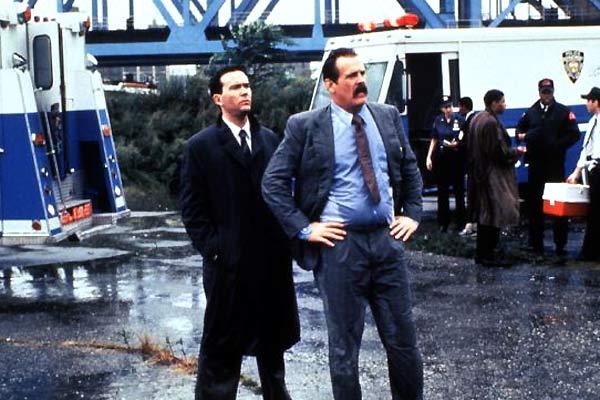
In 1990, prolific director Sidney Lumet released his latest feature film, Q&A. The plot focuses on Michael Brennan (Nick Nolte), a New York City cop who has murdered a criminal in cold blood and made it look like self-defense. A young rising district attorney, Al Reilly (Timothy Hutton), is assigned to what he’s told will be a simple case. As he digs deeper, he discovers Brennan’s complicated misdeeds. The veteran cop bullies and intimidates witnesses, covers his tracks with lies, and ultimately kills to keep his secrets. He’s empowered by higher ups in the system who look the other way or mobsters who provide the additional muscle he needs. But Al refuses to enable Brennan. He’s committed to upholding the law, even if it could get him killed.
During his investigation, Al encounters Bobby Texador (Armand Assante), a notorious drug boss who witnessed the murder. He’s a colorful character that just so happens to be dating Al’s ex-girlfriend, Nancy (Jenny Lumet). Al still loves her and regrets the breakup. This is actually one problem I found with the movie. Every time Al and Nancy are on screen together the movie grinds to a halt. Nobody cares. The audience for this film didn’t come to see a stale love story. The better interactions are between Hutton and Nolte or Hutton and Assante. They are all excellent in their roles and have great chemistry.
Lumet adapted the screenplay from Edwin Torres’ novel of the same name and it’s easy to see why he was drawn to the material. The book uses themes that the director had explored before in his movies (Serpico, Prince of the City, The Verdict): corruption, abuse of power, and the little guy fighting back against it all. Lumet expertly weaves a David & Goliath story into a crime thriller, adding complexity to the gritty action. The film also touches on issues of race, class, and sexuality. The last one, specifically how the LGBT characters are treated, could have been executed better though.
Q&A didn’t perform well at the box office or get a lot of acclaim from the critics, but I find it to be an interesting film. Even though Lumet has gone down this road before he manages to cover the material from a fresh perspective. It’s still worth taking a look all these years later.
I enjoy celebrating Easter Sunday by watching Godspell, which is as close as I wanna get to church. The film, based on the stage play of the same name, came out in 1973. That same year another musical about Jesus Christ, of the Superstar variety, was also released. I prefer Godspell, mainly because it’s so wacky. The gist of it is that Jesus (Victor Garber), John the Baptist/Judas (David Haskell), and a bunch of hippie disciples are traipsing around an empty New York City reenacting parables, singing, and dancing. It’s like a Sunday school lesson on acid. The cast, led by a baby-faced Garber, is very talented. You also have beautiful shots of early 70s NYC, including the recently built World Trade Center. The music is my favorite part, though. These are my top three songs.
Day by Day
When the hippie troupe first comes together, they sing this number while building their home base in an old junk yard. It’s a fun one to sing and clap along to, if the spirit moves you.
By My Side
A beautiful ballad with perfect overlapping harmonies. I like how stripped down it is.
Turn Back, O Man
This sultry number contains the line, “Come here Jesus, I got something to show you”. WTF?? But, I’m here for it. They filmed this at the historic Andrew Carnegie mansion. Great setting.
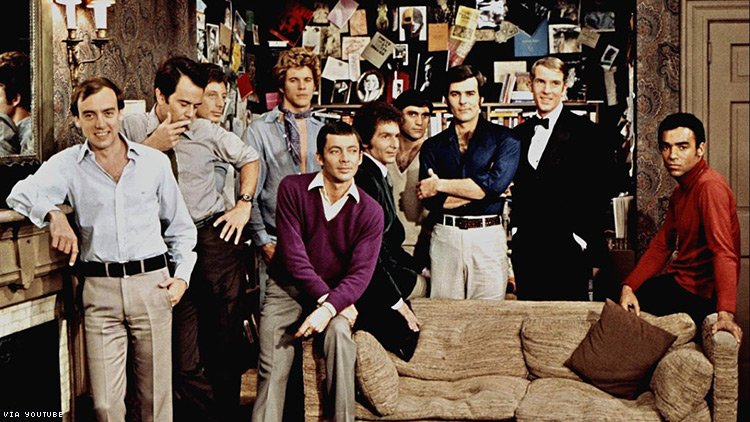
Fifty years ago this month, The Boys in the Band debuted in theaters. The movie was groundbreaking in depicting gay men and their lives at a time when it was taboo to do so. Other films alluded to homosexuality or danced around the subject. Boys put everything out in the open with three dimensional characters and plot lines. Warts and all. That’s what makes it so memorable.
Stage to screen
In 1968, Mart Crowley was struggling to establish his career as a writer. His friends encouraged him to develop a play, which ultimately became The Boys in the Band. The story focuses on nine gay men who have gathered together for a birthday celebration. At first the tone is fun and not-so-serious, but halfway through things take a turn. You wouldn’t want to be invited to this party. Boys debuted Off-Broadway and instantly became a hit, running for 1,001 performances. This led to a film adaptation written by Crowley and starring the original actors from the show. Robert Moore, the play’s director, was dropped because he had never directed for the screen. The production company instead hired a young pre-Exorcist William Friedkin and shooting began. The majority of filming took place on one stage in a NYC studio, maintaining the static feel of the play. That beautifully 1970s apartment set is one of my favorites from any movie.
Breaking down the boys
Even though it’s not his birthday, Michael (Kenneth Nelson) manages to take center stage. He’s deeply troubled about his life and that comes pouring out as the play goes on. The main reason for his drama is his sexuality. He drinks excessively and attacks others rather than deal with his issues. Nelson expertly plays Michael’s highs and lows, going from jovial to lethal in a second.
Harold (Leonard Frey), the birthday boy, is Michael’s best friend and sometimes his worst enemy. They love to trade barbs and tear each other down. They’re very similar except Harold does a better job of distracting from his insecurities and faults. His acidic wit hides a lot of pain.
Donald (Frederick Combs) is Michael’s ex-boyfriend, but they still care for each other. Like Michael, he’s not too happy with himself. Do you see a pattern? But he’s seeing a psychiatrist to deal with his problems. Ironically, he ends up being Michael’s shrink in a sense, but fails to save him from himself.
Alan (Peter White) crashes the party and changes the entire mood. Before arriving, he calls Michael, telling him that he desperately needs to talk in person. Michael believes his straight married friend is actually gay and on the verge of coming out. If Alan’s not willing to do so on his own, Michael will drag him out of the closet.
Flamboyant Emory (Cliff Gorman) is a textbook sissy, swishing and mincing through every scene. Some might argue that a character like this shouldn’t have been included in the play. But Crowley and Gorman give Emory depth beyond the superficial stereotype. I also think he’s the strongest one at the party. He’s unabashedly himself, refusing to change for anyone.
Bernard (Reuben Greene) acts as the one black friend in the group. It’s a little surprising that Crowley included a person of color when it could have easily been an all-white affair, reflecting the era. He’s not a token either. Bernard’s race does become a focal point, but he’s also a fully-formed character.
Hank (Laurence Luckinbill) and Larry (Keith Prentice) are a couple, but they’re not in sync. Hank was once married to a woman and he’s eager to have that same sort of relationship. Larry is allergic to commitment and would rather play the field. Their differing points of view make for an interesting conversation about monogamy in the gay world.
Cowboy (Robert La Tourneaux), a hustler that Emory finds on the street, is Harold’s birthday present. We never learn much about him, including his real name. He’s mainly there to say stupid things for comic effect. But to La Tourneaux’s credit, it takes a good actor to play dumb so well.
Backlash
In between the stage play and the release of the movie came a major event: Stonewall. The riots at a gay bar in NYC where members of the LGBT community fought back against injustice, kicked off the gay liberation movement. Gays felt empowered to break out of the closet and feel proud. So just like that, Boys became obsolete. A story about a bunch of self-hating gay men felt out of touch with what was going on in the world. Yes, it was great to have a film that focused primarily on gays, but the way they were portrayed was repellent to most in the community. When you’re seeking representation onscreen, something so seemingly negative can be disheartening. Nobody wants to be a miserable gay.
Legacy
Over the years, the film has gained more good will, though. I think this is because new, younger audiences are seeing it. These are people who didn’t live through that time period and are somewhat detached from it. They can only imagine what pre-Stonewall life was like, so the film doesn’t feel as personal or hurtful. It’s just a movie now, whereas for gay men in 1970 it was a reality from which they wanted to escape. But I think it’s actually good to look back at a film like Boys and appreciate how far we’ve come. Also, artistically, it’s captivating and well-conceived.
In 2018, the play finally made it to Broadway. Ryan Murphy produced the revival that proudly featured a cast made up entirely of openly gay actors. The show was extremely successful and won Best Revival at the Tony Awards. Crowley accepted the honor and gave a tearful speech honoring the original cast of Boys. It was an incredible full circle moment. Unfortunately, Crowley died earlier this year. I’m glad he got the chance to receive that acclaim after so much criticism was leveled against his work in the past. He didn’t need the justification, but he deserved it. Later in 2020, another film adaptation, starring the same cast from the revival, will be coming to Netflix. I’m anxious to see this new chapter of Boys and revisit a great story.
In 1978, Jamie Lee Curtis starred in John Carpenter’s Halloween. The low budget independent film grossed 70 million at the box office, launched several sequels, and changed the horror landscape. It also made Curtis an in-demand actress. Not surprisingly she was offered several roles in horror movies. She made three that were released in 1980: The Fog, Prom Night, and Terror Train. To celebrate their 40th anniversaries I’m rating them based on their scares, the level of Jamie Lee-ness, humor, and the hot guy quotient. Very scientific.
The Fog
Curtis and Carpenter teamed up again for this ghost story. Set in fictional Antonio Bay, Fog follows the locals as they prepare to celebrate the town’s 100th anniversary. Strange occurrences begin as an eerie fog rolls in from the coast. At the same time, Father Malone (Hal Holbrook) discovers a long-buried secret in the church. In 1880, the founders of Antonio Bay ambushed a ship that was coming to the area to establish a leper colony. The crew died and their gold was stolen by the founders to build the town. Now the ghosts of those wronged men have come back, in the fog, to seek revenge. JLC plays Elizabeth, a hitchhiker who arrives on this deadly scene after being picked up by Antonio Bay resident Nick (Tom Atkins). Another reason why you shouldn’t hitchhike.
Is it scary…?
Very much so. Just like with Halloween, Carpenter creates an unsettling suspenseful film. Yes, the special effects with the fog are hokey by today’s standards, but they do add an eerie factor to the movie. The ghosts popping up and dragging people away are also frightening.
Jamie Lee-ness…
She’s more of a supporting player here. The real star of the film is Adrienne Barbeau, who plays silky-voiced radio DJ, Stevie. She just happened to be Carpenter’s wife at the time too. But there is a cool bit of casting with Janet Leigh, Jamie’s mother and fellow Scream Queen, taking on the role of the town member who is organizing the centennial celebration.
Humor…
Nancy Loomis, another actor from Halloween, plays a deadpan Sandy. She throws out a lot of great one-liners to liven up the mood.
Hot Guys…
If you consider Atkins hot, more power to you. I’m not quite sure why he was chosen to play Curtis’ love interest when there’s a very noticeable 23-year age difference between them. Aside from him there’s not much to look at man-wise here.
Prom Night
A group of preteens accidentally kill one of their classmates. Sidenote, you shouldn’t play in old abandoned schools with broken windows that you can easily fall through. The four friends vow to keep the accident a secret. Too bad someone else witnessed the deed. Six years later the four friends are attending their senior prom. There’s bitchy Wendy (Anne-Marie Martin), prudish Kelly (Mary Beth Rubens), dorky Jude (Joy Thompson), and sweet cute guy Nick (Casey Stevens). The story also focuses on their dead classmate’s sister Kim (Curtis). Her family never got over her loss, but they’re trying to put it behind them for the sake of prom. As you do. Unfortunately, a crazed killer is out for revenge and will be attending the dance too.
Is it scary…?
Well, sorta. Prom is very slow and takes a long time to get started. An hour goes by before someone from the main cast gets murdered. In fact, it’s more like a teen drama with its soapy relationship plotlines. But the movie does have an intense sequence where Wendy (who looks and acts like a low budget Nancy Allen) is chased through the school by the killer. There are a lot of near misses that keep you on the edge of your seat. Another helpful hint, if you’re hiding from a killer, try not to scream loudly and draw attention to yourself.
Jamie Lee-ness…
This is a good role for Jamie even though she doesn’t really get into the action until the end. Up until that point she just walks around looking creeped out, while the killer comes after her classmates. When she and the psycho finally have a run-in, he tries to kill Nick and she has to rescue him. It’s a nice change from the usual horror set up.
Humor…
There’s some unintentional comedy. The “Disco Madness” theme for the prom really kicks in when Kim and Nick do an elaborately choreographed dance number. Who knew Jamie Lee could do the robot? It’s all…something. But I must admit that I really like the song (“Prom Night”) that they’re grooving to.
Hot Guys…
Stevens supplies most of the eye candy with his golden curly locks. Also, Kelly’s boyfriend, Drew (Jeff Wincott) may be a jerk, but he’s cute.
Terror Train
A fraternity prank gone wrong leads to murder. Has there ever been a fraternity prank that has actually gone right? Doc (Hart Bochner), Mo (Timothy Webber), Ed (Howard Busgang), and Jackson (Anthony Sherwood) lure their naïve pledge, Kenny (Derek MacKinnon), into a darkened room with the promise of a hookup with a girl, Alana (Curtis). But instead Kenny finds himself cozying up to a corpse. The trick traumatizes him and he’s sent to a psychiatric hospital. Three years later, the fraternity throws a huge party on a train for New Year’s Eve. What they don’t know is that a killer is also on board and taking them out one by one.
Is it scary…?
From the beginning, the movie sets an ominous tone. Being trapped on a train with nowhere to escape from a killer is frightening and claustrophobic. The lighting for the film is often very dark, making every corner a potential hiding place. Plus, the party on board is a masquerade, which equals creepy masks.
Jamie Lee-ness…
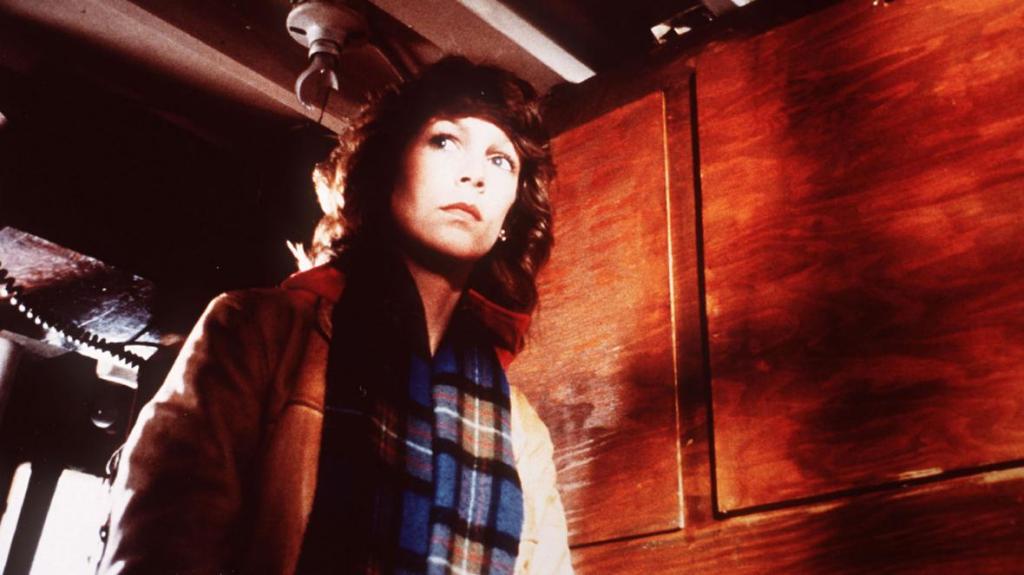
This is the only movie of the three where JLC receives top billing. She is featured in the majority of the scenes, fighting with her boyfriend or running like hell from a psychopath. In the last act, she has to evade the villain while being trapped in a small train car and then a cage. She plays the tension well.
Humor…
Again, there’s some unintentional humor courtesy of David Copperfield. He’s the magician (a stretch) who has been booked for the party, doing tricks while cheesy disco music plays in the background. It’s like if Travolta did magic. I couldn’t help but giggle.
Hot Guys…
There’s some interesting chemistry between fraternity brothers Doc and Mo. Doc spends most of the trip trying to break up Mo and Alana. At one point he stares intensely at his bro and reminds him that if Alana leaves him, Mo still has him. I bet. The movie needed more scenes like this. You could also say Copperfield is hot. It worked for supermodel Claudia Schiffer.
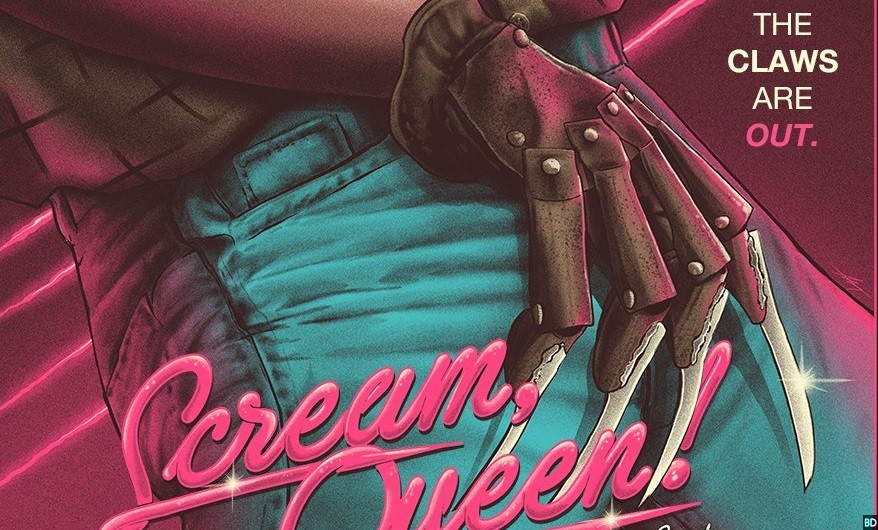
The documentary Scream, Queen! My Nightmare on Elm Street thoroughly delves into the history of A Nightmare on Elm Street 2: Freddy’s Revenge and the effect it had on its star, Mark Patton. It’s an interesting look at how a movie can change someone’s life for better or worse.
In the first Elm Street, a group of teenagers are stalked and killed by boogeyman Freddy Kruger (Robert Englund) in their nightmares. Nancy (Heather Langenkamp), the final girl, survives and defeats him. The movie did extremely well at the box office and led to a sequel being rushed into production. Part 2 strayed from the original’s formula though. For starters, the final girl was replaced with a guy, Jesse (Patton). That wasn’t something you normally saw back then. Also, Freddy wasn’t just haunting Jesse, he wanted to possess him and escape the dream world. The movie was moderately successful compared to the first. The biggest critique, mainly coming from straight men, was that it was too gay. They weren’t that off base.
In the film, Freddy wants to “get inside Jesse’s body” and his interactions with his prey are quite homoerotic. Then there’s Jesse’s possibly gay gym teacher, Coach Schneider (Marshall Bell). Jesse dreams about running into him in at a leather bar. Later, Schneider is stripped (rare male nudity) and whipped with towels. Seriously. There’s also the notion that Jesse (and Patton) wasn’t masculine enough. It was said that he was too sensitive and screamed like a girl. The criticism negatively impacted Patton’s life. At the time he was a closeted actor trying to make it in Hollywood, so he worried that being associated with anything gay would derail his career. This was also 1985, the height of the AIDS epidemic. Gay equalled diseased and ultimately blacklisted. Patton discovered he was HIV-positive and retreated from acting. He went off the grid and moved to Mexico.
The documentary cuts to the present day with Patton coming to terms with Freddy’sRevenge. He’s still hurt by the jabs about his performance in the film and blames one person in particular, the screenwriter. For decades, David Chaskin denied that he purposely put gay elements into his script. Instead he inferred that Patton made the movie gay. But he never had a conversation with Patton about it either way. Luckily, the documentary captures their long-time-coming meetup. The film also shows Patton interacting with his former castmates, going to horror movie conventions, and doing Q&A’s after screenings of Freddy’sRevenge. You see that he’s accepted the legacy of the movie and Jesse. Yes, he still has issues from his past experiences, but he has been able to move on and create a good life for himself outside of Hollywood. Instead of becoming bitter he has a sense of humor about the situation. Plus, the once panned movie has now become a cult classic for many.
I like that Scream, Queen! co-directors Roman Chimienti and Tyler Jensen also focus on the overall appeal of horror movies to gay audiences. Many of the interviewees are fans of the genre who talk about escaping from their own harsh realities through these films. As outsiders, they find strength in seeing the protagonist fight back and beat the evil that is out to get them. It’s even more meaningful when a gay character or theme is added to the mix. The filmmakers show how powerful it is when a horror fan can identify with these movies with one fan mentioning how Jesse inspired him. Hopefully, in the future there will be more final “out of the ordinary” guys in horror movies and it won’t be so scary.
In theory, Cruising probably sounded like a great idea 40 years ago. An exciting thriller directed by Academy Award winner William Friedkin and starring celebrated actor Al Pacino. It should have been a winner, but instead it became one of the most panned films of 1980. Where did it all go wrong?
Backstory
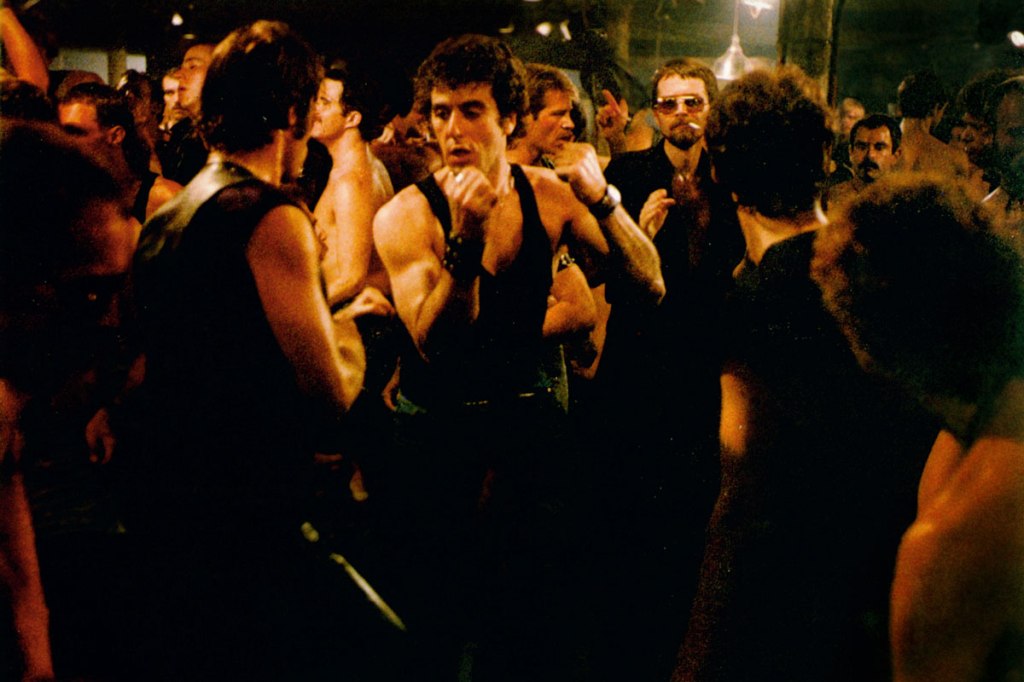
Th film is set in New York’s gay S&M and leather scene in the late 70s. A serial killer is picking up men, having sex with them, and killing them. Police Captain Edelson (Paul Sorvino) assigns officer Steve Burns (Pacino) to go undercover in the gay community to catch the murderer. As Steve delves further into the case, he begins to lose himself in the world he’s inhabiting and grows distant from his girlfriend Nancy (Karen Allen).
Friedkin wrote the screenplay by drawing from a few different sources. There was the novel of the same name written by Gerald Walker in 1970. I’ve read it and it’s horrible. Zero redeeming qualities. Much of it is told from the POV of the killer who is extremely racist, homophobic, and sexist. So, it’s not fun to be in his head page after page. Luckily, Friedkin only used the outline of the novel and threw out the rest. There were also the real-life murders in the 70s in NYC. Several gay men were brutally killed, dismembered, and placed in trash bags that were tossed into the Hudson River. Friedkin studied Arthur Bell’s articles in the Village Voice newspaper chronicling the case. At one point a suspect, Paul Bateson, was arrested, but it was never concretely proven that he was the killer. In a crazy coincidence, Bateson appeared in a small role in Friedkin’s film The Exorcist a few years before Cruising came out.
Mystery
Friedkin took all of these elements and blended them together. Unfortunately, the concoction is messy. First, the script is uneven. It starts off with a great premise for a murder mystery, but quickly gets lost. There are a lot of scenes that go nowhere with Steve wandering through the bars or other cruising grounds. We see his wide-eyed reactions to the supposedly crazy things he’s seeing, which comes off as comical rather than suspenseful. As the film progresses, he becomes more uncomfortable with his assignment, but we don’t know why it’s messing with his head. Is he actually gay? Does he like this new scene he finds himself in, which scares him and causes him to retreat from his girlfriend?
In the third act Steve zeroes in on a suspect, Stuart (Richard Cox), a college student in the city. We’ve seen glimpses of him in earlier scenes, but now the audience learns that he’s a closet case with father issues. Not very original. He could be killing these men because he hates himself. Or he’s doing it to appease his disapproving father. His motivations aren’t revealed. It’s also confusing because in earlier scenes featuring the killer he appears to be played by a different actor. Were there multiple murderers? This leads to an open ending where Friedkin makes us suspect the Steve could possibly be the killer. I’m not asking for everything to be spelled out, but it can be dissatisfying when a film gives you more questions than answers. It has been reported that Friedkin had to remove a lot of footage from the final cut in order to avoid an X-rating. Maybe the answers were lost with those edits.
Pacino
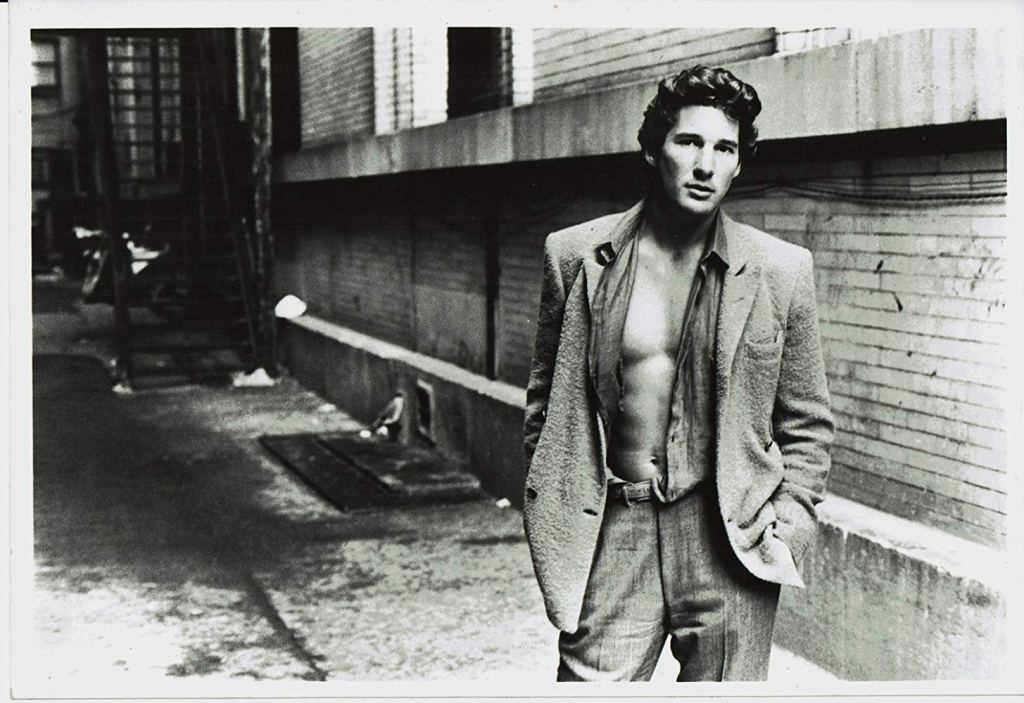
Even though Pacino was a great actor doesn’t mean he was the right guy for this film. For one, he was too old. Not that 40 is ancient, but it’s a leap from the 30-year-old that he was supposed to be playing. Plus, he was looking particularly rough at this point. Maybe from working so much over the past decade. Then there’s the fact that his character is supposed to hide behind the persona he’s taking on while undercover. But when you have a well know actor with very identifiable characteristics, you can’t see anything but him. As a result, there’s no real transformation. Pacino also has a tendency to overact. He’s dialing it up to a 10 when a 5 or lower would have sufficed, like the scene where Steve does poppers and dances. Wow. Richard Gere was actually interested in the role and was in negotiations with Friedkin, but Pacino came along and inadvertently pushed him out. Gere would have been a much better choice. Physically he fit the character more. Plus, he wasn’t very well known at this point in his career and could have easily disappeared into the role. On the other hand, if Gere had been cast, he might have missed out on the opportunity to star in his breakthrough film, American Gigolo, that came out the same year.
Controversy
If gay activists had their way, Cruising would have never been released. From the moment the film was announced, they condemned it. The thinking was that it would portray the gay community in a negative light: depraved, immoral, and psychotic. There was also the fear that the movie would inspire copycat killers who would target gay men. When production started the protesters arrived on set as well. Crowds of people yelled, banged on pans, or blasted air horns. As a result, the actors’ dialogue for scenes shot on location had to be dubbed in post-production because they couldn’t use the sound. Some gay bars refused to let Friedkin shoot on the premises, wanting to avoid any ties to the backlash. I understand where the protesters were coming from, but I think they should have waited to see the film before trying to take it down. Instead, after Cruising was released, they urged theaters not to show it and a handful complied. Reviews from critics were also extremely negative. The movie made 19.8 million at the box office. Not a total bomb, but far from a hit.
Good Points
Not everything about Cruising is wrong, though. For one, it captures a time in New York that can never be replicated: the gritty 70s era. It’s one of the best periods. The city was dark and dirty, but it had great character. I like seeing the neighborhoods, parks, or old businesses that have since changed. A few of the leather bars allowed Friedkin to film inside and their patrons were featured in the background. It’s interesting look in on this moment in gay history, post-Stonewall and pre-AIDS.
The movie also has an incredible soundtrack. In the 70s, gay bars, even the leather ones, were playing disco. Friedkin decided that music didn’t fit the film he was making and replaced it with hard rock and punk. The soundtrack features bands like the Germs, Rough Trade, and the Cripples. It really works. For a story about a serial killer you need sinister music blaring at you. I bought the deluxe vinyl re-release last year. Mutiny’s “Lump” and Willy DeVille’s “Heat of the Moment” are two of my favorites.
In the end, Cruising isn’t terrible. There are worse things out there. Did I mention the book? In addition to the locations and the music, the film is shot very well. There’s a charismatic group of supporting players, like Don Scardino (Ted) and Gene Davis (DaVinci). And, it’s a memorable film. It stays with you. Probably because you’re still seeking answers to all those unanswered questions. Yes, it definitely could have been executed better, but I actually like it for what it is, including the flaws.
Richard Gere has coincidently starred in two iconic movies that centered around prostitutes in LA. American Gigolo came out in 1980 followed by Pretty Woman ten years later in 1990. Until recently when I re-watched both I didn’t stop to think about the parallels between the two. Or how they both feature Hector Elizondo. Let’s compare and contrast for their anniversaries.
Story
American Gigolo tells the story of Julian Kaye, a high-class male escort. He’s refined, elegant, classy, wears designer suits, and speaks multiple languages. His clients, wealthy older women, continually seek out his services. Things are going well for Julian until he is set up with a bad trick. That woman ends up dead not long after their encounter and her murder is pinned on him. In the midst of all this he meets Michelle (Lauren Hutton), a rich politician’s wife. They fall for each other as he attempts to clear his name.
Pretty Woman finds Gere playing Edward Lewis a powerful corporate raider that happens upon Vivian (Julia Roberts), a prostitute, one night on Hollywood Blvd. They have an instant connection and he hires her as his escort for the week. Rough around the edges Vivian is out of place in his high society world. Despite their differences, though, they grow closer and take their relationship beyond a business arrangement.
Love
Romance takes a back seat to the mystery in Gigolo. It makes sense. This is a thriller, not a love story. But, the relationship between Julian and Michelle could have been developed more. They meet, chat for a few minutes, and instantly she’s obsessed with him. At one point she stalks him through the streets of Westwood. It’s unclear why she is so drawn to him, aside from his looks and charm. We never know her motivations because her character is so paper thin. She exists primarily to prop up Julian. After he gets framed, Michelle risks everything to help prove his innocence. She is the only one who cares about him, but the film doesn’t give us any reason to care about her. For his part, I think what makes her most desirable to Julian is her extreme devotion to him.
The relationship between Edward and Vivian is at the forefront of Woman. It’s actually a great story about two people falling in love. Over the course of the movie they share intimate details about themselves and get to know each other. Edward tells Vivian about his heartless father leaving his family and how that shaped him as a person. She responds by letting him in on her rocky upbringing. They feel comfortable being vulnerable with one another. There’s also the romantic dates and beautiful love scenes. At one point, Vivian breaks her rule about not kissing a client on the mouth because by that point Edward is no longer just another number.
Interestingly, in both movies Gere’s characters think they don’t need love or are incapable of maintaining a real relationship. Julian sees women as transactions. He’s not looking for any attachments until Michelle comes along and changes his thinking. But he pushes her away after he’s arrested for murder, telling her he’s not worth ruining her life. He doesn’t want to drag her down. She ignores him and stays by his side, proving to him that he is worthy. Similarly, because of his past family drama Edward doesn’t make room in his life for love. In the opening scene of the film his girlfriend dumps him because he won’t make her a priority in his life. He nearly ruins things with Vivian too. When she tells him that she loves him, he doesn’t share how he really feels. Instead he offers to make her a kept woman, as if money is what she wants. He finally gets a clue at the end of the movie and shows Vivian how much he loves her.
Supporting Players
As mentioned earlier, Hector Elizondo is a prominent player in both films. In Gigolo he’s Detective Sunday, the cop overseeing the murder investigation. He doggedly pursues Julian, eager to find him guilty. Woman finds him playing Barney Thompson, the manager of the Beverly Hills hotel where Edward is staying. He takes pity on Vivian when she’s shunned by the snooty Rodeo Drive sales ladies, becoming her confidant. In both instances, Elizondo brings something interesting to what could have been two ordinary roles. A dash of humor and some flair. Also, in the case of Woman, a pretty obvious toupee.
These films have some truly horrible villains. There’s Leon (Bill Duke) the vengeful pimp. Julian left him years before the movie starts and he’s been pissed ever since. Spoiler alert…Leon is the one who is framing Julian. Woman has Stuckey, played with an incredible amount of sliminess by Jason Alexander. He’s Edward’s lawyer who can’t stand it when his client wants to focus less on making money and more on love. At one point, Stuckey tries to rape Vivian. Luckily, Edward arrives and kicks his ass. He actually ends up better off than Leon who gets pushed off a balcony. He had it coming.
Also, old Hollywood star Ralph Bellamy makes his last film appearance in Woman as the owner of a company that Edward is trying to take over. It’s a small part, but not a bad way to end your career. Plus, Bellamy was probably glad he hung around long enough so that Disorderlies wasn’t his last film.
Soundtracks
Gigolo begins with Julian driving down the California coast in his Mercedes as Blondie’s “Call Me” blares from the radio. Of course, the title and lyrics are prefect for a movie about a call boy, but the track also captures the feel of the early 80s. A little bit of leftover disco with some rock sprinkled in. Pieces of “Call Me” show up in the movie’s score. Sometimes upbeat, sometimes eerie. It’s a versatile piece of music. Famed disco producer, Giorgio Moroder, composed the song and the rest of Gigolo’s soundtrack. The album went to #7 on the Billboard 200 and “Call Me” spent six weeks at #1 on the Billboard 100. I’m also a fan of the Cheryl Barnes song “Love and Passion” that plays in a disco scene. It’s a fun track.
You can’t think of Pretty Woman without hearing Roy Orbion’s classic “Oh Pretty Woman” that inspired the film’s title. Originally released in 1964, the song was launched back into the zeitgeist when the movie came out. It pops up during one of the best shopping montages in cinematic history. Not an exaggeration, I love seeing Vivian shop. The soundtrack would go on to be certified triple platinum and produce hits like Roxette’s “It Must Have Been Love”, Natalie Cole’s “Wild Women”, and Go West’s “King of Wishful Thinking”. Classic early 90s tunes.
Legacy
At the time of its release Gigolo was a novel concept. You didn’t find too many narratives about male prostitutes back them. Moreover, you didn’t often see men sexualized in the way that the film does. Director Paul Schrader celebrates Gere’s beauty in almost every scene, training the camera on his amazing face and body. This was the first mainstream movie where the male lead does full frontal nudity. And it’s not just a quick flash. So much of Gigolo is about visuals really, from the fashion to the lighting to the ornate sets. I wish there was an equal amount of substance. Yes, the film is beautiful to look at, but it often feels empty. The writing is clunky at times and the mystery, in particular, is weak. Despite these faults, Gigolo is an interesting time capsule from the early 80s.
Woman’s premise doesn’t seem like something that you could make an endearing romantic comedy out of. A fairytale love story between a prostitute and her john? That goes beyond your typical hooker with a heart of gold story. But it works. The star power from the leads, their chemistry, and a winning screenplay all come together nicely. Director Gary Marshall crafted a timeless film that holds up years later. You could come across Woman on TV (probably Bravo on a Sunday afternoon) and be just as engaged as audiences were back in 1990. The sign of a true classic.
Sam Mendes’ 1917 follows two young soldiers on a dangerous mission during WWI. In the film, Schofield (George MacKay) and Blake (Dean-Charles Chapman) are tasked with warning a British battalion that they are walking into a trap set by the German army. If they fail, 1,600 lives will be lost, including Blake’s brother (Richard Madden). The two men have to make it through enemy territory to the front line with very little time to spare.
The film was shot and edited to look like one long continuous take. This technique makes everything feel more contained and personal, as if you are alongside Schofield and Blake as they charge into claustrophobic spaces, crawl under barbed-wire, and dodge bullets. Mendes, who also co-wrote the screenplay, creates a nerve-wracking narrative with few breaks in the tension. There’s also the stunning cinematography from Roger Deakins, literally getting the viewer in trenches. In addition, MacKay and Chapman expertly convey the bravery and terror, along with a host of other emotions, that their characters are experiencing.
Mendes has said that he intended 1917 to be more of a thriller and less of a conventional war movie. He succeeds. Yes, history buffs will probably enjoy it, but this isn’t a stuffy boring story. It’s a compelling film that immerses you in these men’s lives and their journey.
I watch the 1974 version of Black Christmas every holiday season. It’s kind of like my own version of It’s a Wonderful Life and certainly more fun than that downer. IAWL is the This is Us of Christmas movies. But I digress. For its 45th anniversary, let’s get into why BC is one of the best holiday horror films.
They’ve got character
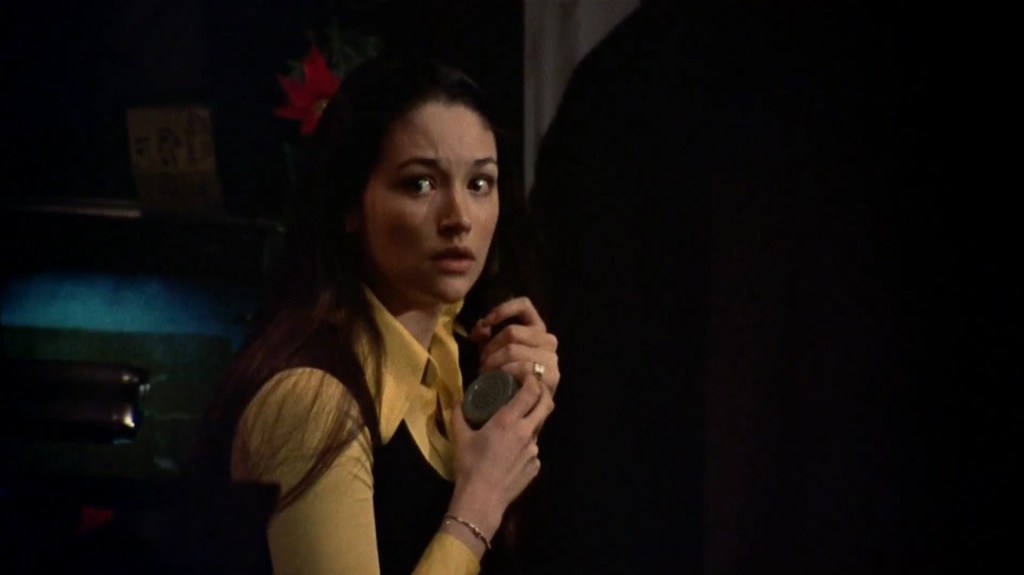
Just like the recent remake, the original is set in a sorority house where a small group of the women are staying over Christmas break. Unbeknowst to them, a psychotic killer has taken up residence in their attic. Creepy attics were made for murderers. Basements aren’t much better. But, back to the sisters. It’s rare in a horror movie to care about the characters. Typically, they’re one dimensional and underdeveloped. Plus, you know they’re going to die soon, so why put in the effort. But in BC, the main group is actually well written and worth giving a crap about. Jess (Olivia Hussey), our final girl, is intelligent, strong, and caring. She has her own mind. In the movie, we find out that she’s pregnant and intends to have an abortion. Even with her boyfriend Peter (Keir Dullea) pressuring her to keep it, she won’t be swayed. It didn’t occur to me until after watching the 2019 BC, with its strong feminist story, that the original already explored that perspective. A young woman making decisions about her body despite a man’s interference is pretty advanced for 1974. Then there’s Barb (Margot Kidder), the clever sardonic sister. She uses her wit and bravado as armor, sometimes hurting others with her sharp tongue. We only see her break once, when she feels guilty because she thinks her harsh words drove Clare (Lynne Griffin) away. It’s only then that Barb’s vulnerability comes out. She’s an interesting flawed person. Finally, kind-hearted Phyl (Andrea Martin) rounds out the trio. She doesn’t get much of a storyline, but you’re still invested in her. She’s a genuine supportive friend to the others. There’s also a good cop in the movie, Lieutenant Fuller (John Saxon). He’s actually smart (don’t see that often in scary movies) and takes the concerns of the girls seriously.
Oh, the horror
From the first shot of the sorority house, director Bob Clark gets you in the mood for what is to come. It’s a dark, cold, eerily quiet night. Then we see, from his POV, as the killer climbs up the side of the house into the attic. Shortly thereafter the phone rings. He’s calling the women, howling and screaming like a maniac. It’s disturbing. The rest of the movie carries on in the same vein. Little things, like the ominous score and sound effects (that duuuuuunnng noise), can be very jarring. There’s not a lot of blood and gore here because you don’t need it in order to scare the viewer (something the 2006 version didn’t comprehend). When Barb is killed, yes you do see blood, but nothing over the top. It’s more unnerving that Clark juxtaposes her death with a children’s choir caroling downstairs at the front door. And who needs gore when you have a ton of suspense? Watching Jess, alone in the living room, unaware that her friends have been killed, frightened by the incessant phone calls, and fearful for what might come next is pure terror. The biggest moment comes when the police, who have been trying to trace the phone calls, discover their origin. They warn Jess with the now classic, “the calls are coming from inside the house”. That should have been followed by a “run, girl!”, since she decides to stay put and look for her friends. Oh Jess. My favorite scare is when the killer chases her and grabs her hair through the bannister. Makes me jump every time.
Comic relief
To break up all these scary moments, Clark and screenwriter Roy Moore add some much-needed humor to the movie. Marian Waldman plays Mrs. Mac, the girls’ boozy house mother. The running joke is she’s always drinking from bottles of alcohol that are hidden around the house. Who knew you could chill your spirits in the toilet tank? There’s also desk sergeant Nash (Douglas McGrath) at the police station. He’s dumber than a box of hair and that’s being generous. The fellatio gag never gets old. “It’s something dirty, ain’t it?” And, of course, Barb brings the laughs with her extended zoo sex story. You’ll never look at turtles the same way again.
Unanswered questions
There are times when a movie doesn’t provide all the answers and you’re actually ok with it. BC falls into this category. There are a lot of plot points left up to the audience to decipher on their own. The biggest one being the identity of the killer. Or a reason for why he is doing this. Also, what was he babbling about on the phone? Similarly, the b-story of the movie focuses on the disappearance of a little girl who is eventually found dead in the park. Could the sorority house killer have been involved? Or maybe there are two murderers running around. And later in the movie, after the police have left unconscious Jess alone in the house with the killer still in the attic, you wonder if he’ll come after her again. But we’ll never know since the movie ends with a…
The original Black Christmas is one of my favorite horror movies. Probably a strong #2 on the list. Because of that I don’t expect a remake to come close to matching it. Especially after that horrible 2006 version. Wow, that was an abysmal movie. So, I went into this new remake of Christmas just hoping it would be an improvement.
In the movie, set at mythical Hawthorne College, a group of sorority sisters are staying on campus during the Christmas break. What they don’t realize is that a masked killer is stalking the grounds, murdering women one by one. It’s a pretty standard set up. But this version of Christmas takes a new feminist stance. We learn that main character Riley (Imogen Poots) was assaulted a few years ago at a fraternity party. Since then she’s been timid and unable to find her voice. As the film progresses, she begins to fight back against the dangerous men who are circling her and her sisters.
I liked idea of injecting a strong dose feminism into a horror movie. Unfortunately, the execution is weak. Writer & director Sophia Takal clumsily handles issues of toxic masculinity, #metoo, and patriarchy. It never really comes together. You feel like she is hitting bullet points rather than smoothly incorporating them into the story. Also, this is a horror movie that isn’t very scary at all. There’s a lack of suspense and thrills. Just a couple of jump scares. But then the worst thing is when the big twist is revealed towards the end. It’s just so damn dumb and completely takes the viewer out of the story.
While I appreciate the idea of a new approach to a classic, this one really missed the mark. However, it’s still ten times better than the shitty 2006 version. So, there’s that.








 NostalGeoff